PUYOL MONTERO, JOSE MARÍA
Table of contents
Prologue 15
Introduction. The Long Road to Building a More Humane Society and Peace 19
Water Tribunal in Valencia: Justice Without Lawyers 23
Grzegorz J. Blicharz
I. INTRODUCTION 24
II. OVERVIEW OF THE WATER TRIBUNAL IN VALENCIA 25
III. RESPECTING THE PRINCIPLE OF SUBSIDIARITY 29
IV. JUSTICE WITHOUT LAWERS? SEEKING NON-ARBITRARY SOLUTIONS 36
V. SPANISH COSTUMARY TRIBUNALS AND THEIR FUTURE 39
VI. CONCLUSION 42
VII. BIBLIOGRAPHY 43
On the So-Called Custom of the Sea, Cannibalism and the Value of Human Life. The Case of Cabin Boy Richard Parker and the Mignonette 45
José-María Puyol Montero
I. INTRODUCTION 46
II. THE CASE OF CABIN BOY RICHARD PARKER 49
III. SOME ETHICAL REFLECTIONS ON THIS CASE AND ON THE SO-CALLED CUSTOM OF THE SEA 63
IV. OTHER CASES ON THE SO-CALLED CUSTOM OF THE SEA AND SOME CONCLUDING REMARKS 73
V. BIBLIOGRAPHY 77
State Neutrality and Human Dignity: Vulnerabilities Against Political Religions 79
Andreea Beatrice Popa
I. INTRODUCTION 80
II. POLITICAL RELIGIONS AND HUMAN DIGNITY 83
2.1 Political religions concept and threat to human dignity 83
2.2 Modern ideologies and current polarization 87
III. STATE NEUTRALITY AS A FRAGILE SAFEGUARD 90
3.1 Legal background of state neutrality and human dignity 90
3.2 Vulnerabilities of neutrality 93
3.3 State neutrality in courts 96
III. FINAL REMARKS 101
IV. BIBLIOGRAPHY 104
The Contours of the Right to Marry in the Council of Europe* 107
Santiago Cañamares Arribas
I. PRELIMINARY REMARKS 107
II. MARRIAGE AS AN INSTITUTION IN THE EUROPEAN CONVENTION ON HUMAN RIGHTS 108
2.1 General description 108
2.2 Monogamy 110
2.3 Sexual diversity 111
2.3.1 From a biological to a morphological approach 111
2.3.2 Same-sex marriages 113
III. THE REGULATION OF RIGHT TO MARRY IN THE EUROPEAN CONVENTION OF HUMAN RIGHTS 115
IV. MARRIAGE SYSTEMS 122
V. FINAL REMARKS 127
Dignity and Rights of People with Disabilities: The Case of the ONCE Social Group in Spain, a Unique Model in the World for the Creation of Social Value from and for People with Disabilities. Disability as an Essential Element of Sustainability and How Disability has a Positive Impact on Organisations Reputation and Value 129
Fernando Riaño Riaño
I. INTRODUCTION 130
II. THE RIGHTS-BASED APPROACH AND THE ROLE OF CIVIL SOCIETY IN DISABILITY 131
2.1 Disabilitys civil society in España: the Spanish Committee of Representatives of People with Disabilities (CERMI) 134
III. KEYS TO THE SITUATION OF PEOPLE WITH DISABILITIES IN SPAIN 135
3.1 Main indicators 135
3.2 Regulatory framework 139
IV. THE ONCE SOCIAL GROUP 140
4.1 ONCE: Over 85 years working for the autonomy and inclusion of blind and visually impaired people 141
4.2 The ONCE Foundation: employment, training and accessibility as key axes for the inclusion of people with disabilities 143
4.3 ILUNION, the social enterprises of ONCE Social Group 144
4.4 Partnerships, sustainability and reputation 145
V. DISABILITY, A CORE ELEMENT OF SUSTAINABILITY AND A KEY ELEMENT IN THE REPUTATION OF ORGANISATIONS 147
From the One Health Approach to the Search of Dignity by the Means of Climate Change and Housing Policy 153
María-Luisa Gómez Jiménez
I. Towards a definition of One Health 154
II. THE NEED FOR AN INTEGRATED RESPONSE FROM A DIGNITY APPROACH: SOME EXAM FROM THE CLIMATE CHANGE PERSPECTIVE IN HOUSING ASPECTS 155
2.1 Acoustic Insulation 155
2.2 Light pollution and use of electricity 158
2.3 Thermal Comfort Management (Heating and Air Conditioning) 160
2.4 Water Use and Management 167
2.5 Protection Against Adverse Events Extreme Weather Events 171
III. SOME TAKES AWAYS 176
IV. BIBLIOGRAPHY 177
The Impact of Financial Size and Performance on Human Rights Policy Adoption: an Analysis of Investment Funds 179
Carlos Arenas-Laorga
I. INTRODUCTION 179
II. LITERATURE REVIEW 181
III. METHODOLOGY 184
IV. RESULTS 187
V. DISCUSSION 191
VI. CONCLUSIONS 194
VII. BIBLIOGRAPHY 195
Wilderness Places in the Law: The Treatment of George Mallory and Approaches to Ancient Human Remains within the Legal Framework of England and Wales 197
Javier García Oliva
Helen Hall
I. INTRODUCTION 198
II. SCOPE OF THE STUDY 199
2.1 Human Remains from Western Societies 200
2.2 Historical Human Remains 203
III. THE 1999 EXPEDITION AND ITS AFTERMATH 207
3.1 Wilderness Space in the Rule of Law: Extreme Physical Environment 219
3.2 Wilderness Space in the Rule of Law: Clear Cultural Norms 223
IV. CONCLUSION 228
4.1 Mallory and Wilderness Spaces 228
4.2 Wider Insights 230
V. BIBLIOGRAPHY (EXCLUDING WEB SOURCES) 231
Deep Brain Stimulation: A Threat to Human Dignity? 235
Luca Valera
José Ignacio Otayza
Rodrigo López Barreda
I. INTRODUCTION. A BRIEF HISTORICAL SKETCH 236
II. EFFECTS OF DBS 238
III. INHERENT AND NON-INHERENT ETHICAL CONCERNS 241
IV. A MEANS TO AN END 243
4.1 The case of Parkinsons disease 244
4.2 The case of addictions 245
V. ADDICTION AND FREEDOM. SOME INTERPRETATIVE FEATURES 247
5.1 Conditions and paradigms of freedom 248
5.2 Compatibilism and incompatibilism 250
VI. CONCLUSIONS. HUMAN DIGNITY @ RISK 252
VII. REFERENCES 253
Perspectives on Human Dignity Regarding Algorithms 257
Manuel Estepa Montero
I. THE IRRUPTION OF AI IN OUR LIVES 257
II. EUROPEAN UNION TAKES NOTE OF THE CHALLENGE OF ARTIFICIAL INTELLIGENCE FOR HUMAN RIGHTS 259
III. THE COUNCIL OF EUROPE APPROVES A FRAMEWORK CONVENTION FOR THE PROTECTION OF HUMAN RIGHTS, DEMOCRACY AND THE RULE OF LAW 264
IV. THE EUROPEAN UNION AIMS TO PRESERVE HUMAN DIGNITY BY ADOPTING AD HOC LEGISLATION 268
4.1 The necessary protection of Fundamental Rights 268
4.2 The ethical framework of artificial intelligence projected by the European Parliament: Artificial intelligence must have the human being as its axis 269
4.3 Existing law promotes the ethical guideline for the construction of AI 274
V. A SPECIFIC PROJECTION: THE DEFENSE OF THE RIGHT TO JUSTICE 277
VI. CONCLUSIONS 281
VII. BIBLIOGRAPHY 283
RCCHU Study Group Studies on Life and Human Dignity 285
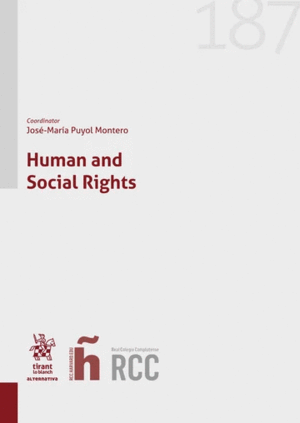
On June 27th and 28th 2024 an international seminar was organized by RCC Study Group "Studies on Life and Human Dignity" at Harvard Law School (Cambridge, Massachusetts). The seminar "Human Dignity and Social Rights" was to gather well-renowned professors from different fields of science from prestigious European and American universities. The aim of the encounter was to analyze and study the concept of human dignity in life and at the end of life, and some of its manifestations and potential threats in today?s world.
In the last decades, a spectacular development in the diverse fields of science, economy, trade and communications has taken place in society. These advances in human progress, as laudable as they may be, often do not effectively correspond to parallel recognition of every man and woman?s human dignity. In fact, in many cases, this progress results in a series of contradictions and possible dangers and challenges.
This book brings together a selection of papers presented at that seminar at Harvard, regarding the big issue of human dignity and law.